
Interdisciplinary project management and workflows
Interdisziplinär project management and the effort behind practical project management is one of the main learning factors in the course. The time periods are divided up by the course structure in both the winter semester and the summer semester, but how exactly this looks for a specific project and whether a project succeeds along the planning is the responsibility of the students.
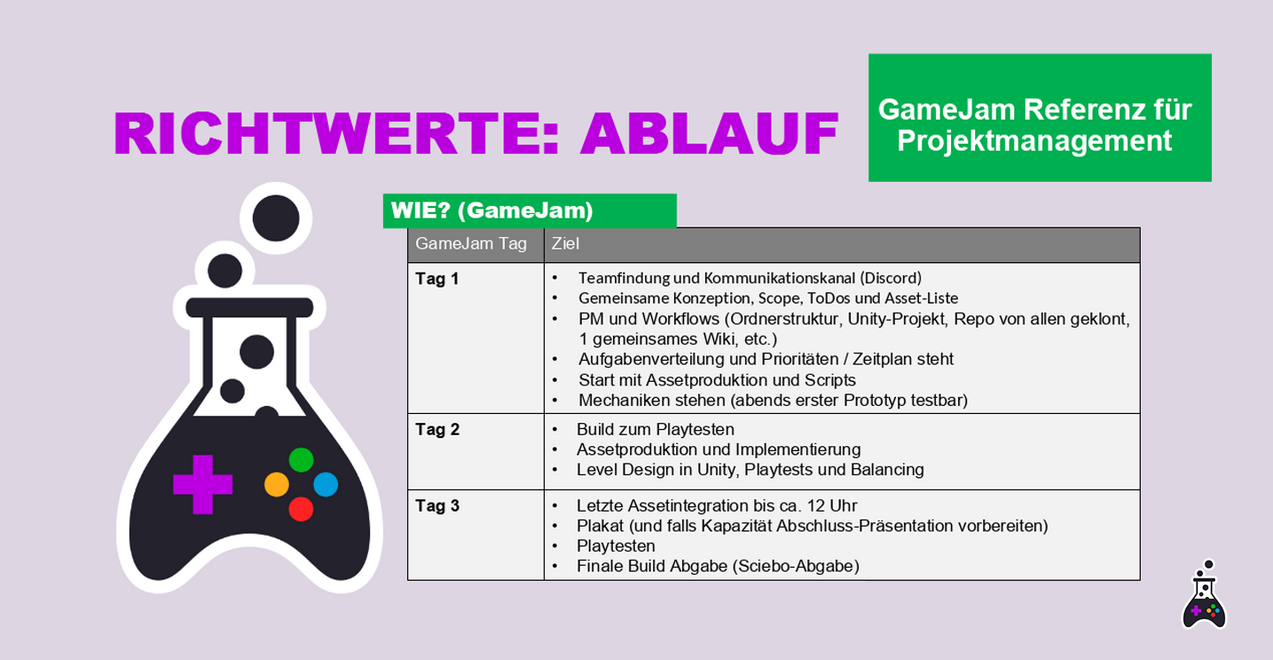
The time management for a prototype during a GameJam, as a prototype that is developed within a block of 48 hours, differs greatly from a semester project. A GameJam prototype goes through the same phases of development, but the conception and decision-making periods are much shorter. This makes a GameJam project somewhat easier to manage than a semester project, but it also requires a lot of energy and focus.
Organisational structures and management concepts
„Regular dialogue is more difficult than you might think. You have to find ways to reach and integrate less communicative team members, even if this is sometimes difficult. It is also important to know people as people and not just as members”

Project processes based on the industry
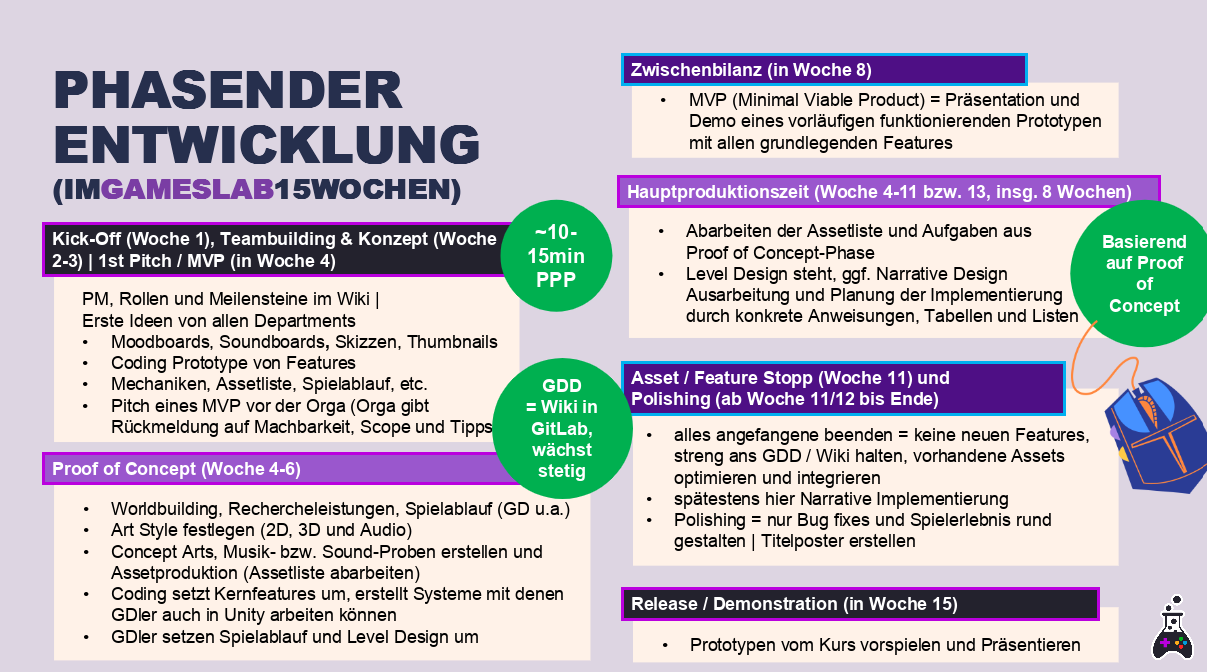
The semester lasts 15 weeks. However, the period in which students can work on a prototype in the summer semester is limited to 12 weeks. Compared to the GameJam (48 hours), this is a long time, but in the industry, the conception phase of a game alone takes three to six months. After a further six to eight months of pre-production, in which the techniques, mechanics and workflows are developed, a team often still has 12-18 months pure for production. This does not include the release and post-release periods.
In the 12 weeks, however, the production teams go through all phases of development, from the pitch to the proof of concept, an interim status, a pre-release and the release. They overcome two major hurdles in the process. Firstly, they all have to independently apply the department skills they learnt in the winter semester to the project. Secondly, the students are often part of a completely new team. This means that they also have to get to know each other on a human level, develop working methods and communication styles and create a team culture.
The core of the learning experience is that long-term projects are fundamentally different in terms of time planning. Interdisziplinär and creative projects also work differently in terms of resource planning than many students are used to from "group work". Here, participants must learn not only to manage their own time, but also to factor in their availability for the project and the team. They have to consider deadlines and team-internal dependencies while fulfilling their other duties outside of the course. For most, this industry-orientated working is a big change and at the same time the biggest learning factor.
Interdisciplinary studies and projects
Interdisciplinary composition of students
The course thrives on the fact that students from a wide range of study programmes come together to work on a project. Our participants are students from Media Studies, Computer Science, Art, Popular Music and Media, Comparative Literature and many other study programmes. The fact that the course can be credited to extracurricular studies means that students from a wide range of Bachelor's and Master's programmes can also come together - and they all come together in the GamesLab and learn from and with each other.
Interdepartmental work and cross-departmental content
Participants also learn to look beyond the boundaries of their departments in terms of content. Although you decide to work in a department in the winter, there are aspects of joint game development that you can only understand and apply efficiently by exchanging ideas with other department participants. The departmental expertise is part of your competence, which you bring to the interdisciplinary team. By working closely with the other departments, you will learn how your areas of responsibility are linked to those of the others, where there are overlaps and why it is important to coordinate and develop together.
Vocabulary list for interdisziplinär project management
In addition to their departmental tasks, the team lead also has the role of leading the production team in time management and project management. This may include tasks such as
- Leading meetings and querying the status quo
- Initiating and maintaining communication between the different departments or individuals
- Maintaining an overview of deadlines (pitches, build submissions, etc.)
- Maintaining an overview of production (asset lists, documentation, etc.)
- etc.
The team leader tends to be a game design person in the team. However, it often happens that the organisation provides support and carries out team lead tasks.
In the case of semester projects, the (department) artist-lead is a person who acts as a link and contact person. They are themselves a participant in one of the departments during the winter semester. You can be a 2D artist lead, 3D artist lead, audio lead, coding lead or game design lead. The role has the following tasks, for example:
- Overview of all artists and their tasks (who is currently working on what?)
- Helps with the distribution of further tasks
- Reports to the team lead in between or in meetings with the production team on the status quo of their own department
- Helps to maintain communication between own department and other departments
The advantage of a (department) artist lead is that the burden of team leader does not have to be carried by game design alone or absorbed by the organisation. The role helps to simplify scheduling and shorten information chains in the production team.
In the course, it is fundamental that you independently design and optimise your work processes. You are responsible for setting your own internal team tasks and deadlines for these. Unlike in other courses, you will not be given a list of tasks that you can work through, but you will have to work through this list yourself for your project.
Vocabulary list for workflows
As we are all working together on one project, we should agree on a common folder structure. Firstly, the Unity project should be completely separated from all other working files from other software. The folders should be structured based on components: A "Player" folder therefore contains all folders relating to the player, e.g. "Scripts", "Materials".
Workflow refers to work sequences. In a narrower sense, workflows describe both work sequences in relation to the personal task. However, this primarily refers to the sequences between departments.
- Which tasks or assets need to be created first and then passed on to whom?
- How do I prepare an asset? From planning to production to integration?
- Which other departments are dependent on my results and what do I need to consider for their further processing?
In industry, the superordinate project processes are often referred to as "pipelines" and the subordinate work processes are workflows.
The GitFlow describes a workflow and best practices that are practised when dealing with all files and project work. We use the Git version control system and try to minimise the risk of errors and conflicts within the repo by using the correct sequence of fetch, pull, commit, push and merge processes.