"The or­gan­isa­tion" - tasks and com­mit­ment

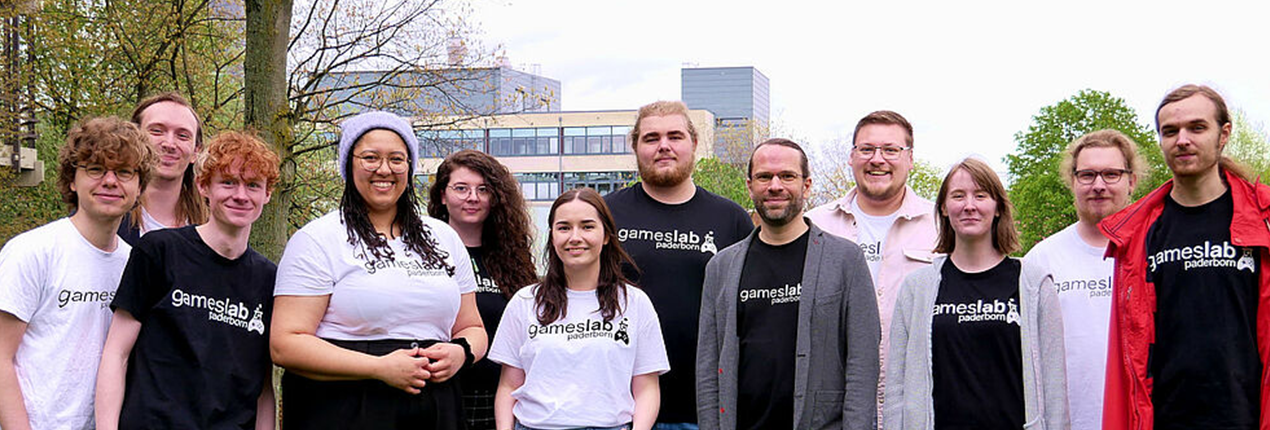
"The Orga" is a team of students who, under the direction of professor Christian Fuchs, research assistant Sebastian Krois and technical assistant Volker Spaarmann, organise the content of the wide-ranging practical course "GamesLab: Video Game Development and Game Studies".

Just like our participants, we are an interdisziplinär team from different study programmes, such as Media Studies, Computer Science, Popular Music and Media or Comparative Literature. Our team size varies, but since 2022 we have grown to a team of around 15 people, who are studying for both Bachelor's and Master's degrees and are aged between 21 and 35.

We bring different experience in terms of game development or project management in creative development work. In some cases, we have orga-persons who, for example, have learnt aspects of the field during their studies abroad, or people who have completed training in the field at the Paderborn BiB. There is also development experience from research projects carried out in cooperation with the SICP. However, most of us start with an intrinsic interest in a department. Building on this, we have learnt our skills through our own continuing/further education, professional development [je nach Kontext] or developed them as part of the GamesLab.

What is im­port­ant to us in the or­gan­isa­tion?

The GamesLab as a so­cial space

We want the participants to feel comfortable and safe in the GamesLab. Harmonious cooperation within the organisation is also important to us. That's why we actively work to foster a healthy, fair and constructive culture of conflict and open communication. We try to work in a solution-orientated way - together and with fun.

In­trins­ic mo­tiv­a­tion

The potential of the GamesLab lies in the fact that it is a place for learning, where you can develop and develop creatively and personally. In order to constantly improve the course, we regularly reflect on our course and workshop content. We update them and actively incorporate participant feedback into the design process.

In­dustry-re­lated work pro­cesses and in­ter­dis­cip­lin­ar­ity

We base our "workflows" on the games industry in order to be able to convey real work processes and the requirements for production, project and team work to the participants. When designing the workshops, we ensure that there is a crossover understanding of the work involved across departments.

„There is a lot to consider, think about, discuss, memorise, plan, implement and learn. Of course, it's fun in the foreground, but the responsibility of planning and running a course so well that up to 120 participants feel well enough prepared should not be underestimated.”

GMTK GameJam 2024 im GamesLab
Anonym,
Orga-Person from Internal Survey: “Orga Feedback 2023-24”

The ex­tent of the or­gan­isa­tion's

Semester plan­ning

Before the start of the semester, we work continuously for about two months to improve and update the course. We plan all the content and link the departments with each other through so-called crossover content. The entire organisation discusses the previous semester or the previous iteration, what hurdles or findings there were, and incorporates these.

De­part­ment and work­shop man­age­ment

As workshop or department (co-)leaders, we create the practical learning content for the respective department (2D, 3D, audio, coding or games design). We teach the participants this content, check homework, give feedback and tips to improve skills and teach crossover aspects relating to the subject.

Game con­cepts and re­view of par­ti­cipant sug­ges­tions

In winter, we put out a survey in which all participants have to submit a proposal for game development. We go through these ideas and turn them into rough game concepts for the GameJam and the semester project. We spend several weeks researching mechanics and references in order to prepare the teams well.

Team man­age­ment and su­per­vi­sion of the semester pro­jects

In winter and summer, we help to ensure that constructive communication is maintained within our project teams and that decisions are made in a solution-orientated manner. We often take on project management and team leadership tasks that cannot yet be carried out completely on our own or independently by the participants.

As­sist­ance for par­ti­cipants

We are the first point of contact for participants if they have questions about the course content or need help with specific tasks. We take the time to help with the programmes, for example.

Problems with Git are also particularly resource-intensive and are solved through skilful searching and targeted workflows.

Open­ing hours, premises and hard­ware

The GamesLab is open for use by students both during the current semester and during the lecture-free period. During the opening hours (at least 3 days a week, usually 11-18h) we are available as contact persons. In addition, various work materials and hardware are available on our premises.

Web­site and so­cial me­dia sup­port

The organisation work also includes conceptual and editorial services such as writing articles, writing game summaries and processing the game prototypes into demos that can be played on the website. Maintaining the online presence also means editing videos, image processing, graphics creation and much more.

Net­work­ing in the games in­dustry & know­ledge stor­age

We maintain contact with professionals who have established themselves in the games industry and actively try to integrate their knowledge and perspectives into our course content.

We also ensure that the knowledge acquired in the organisation about game development, team leadership and other aspects is passed on and systematised across generations.

Feed­back and coun­selling as­pects

Within the course and also for other creative projects, we are happy to provide feedback or assistance. For example, there have been times when students have needed dubbing actors for their project. Or students come to us with questions about departmental work and ask for tips or help - we're happy to do that.

The in­vis­ible work of the orga

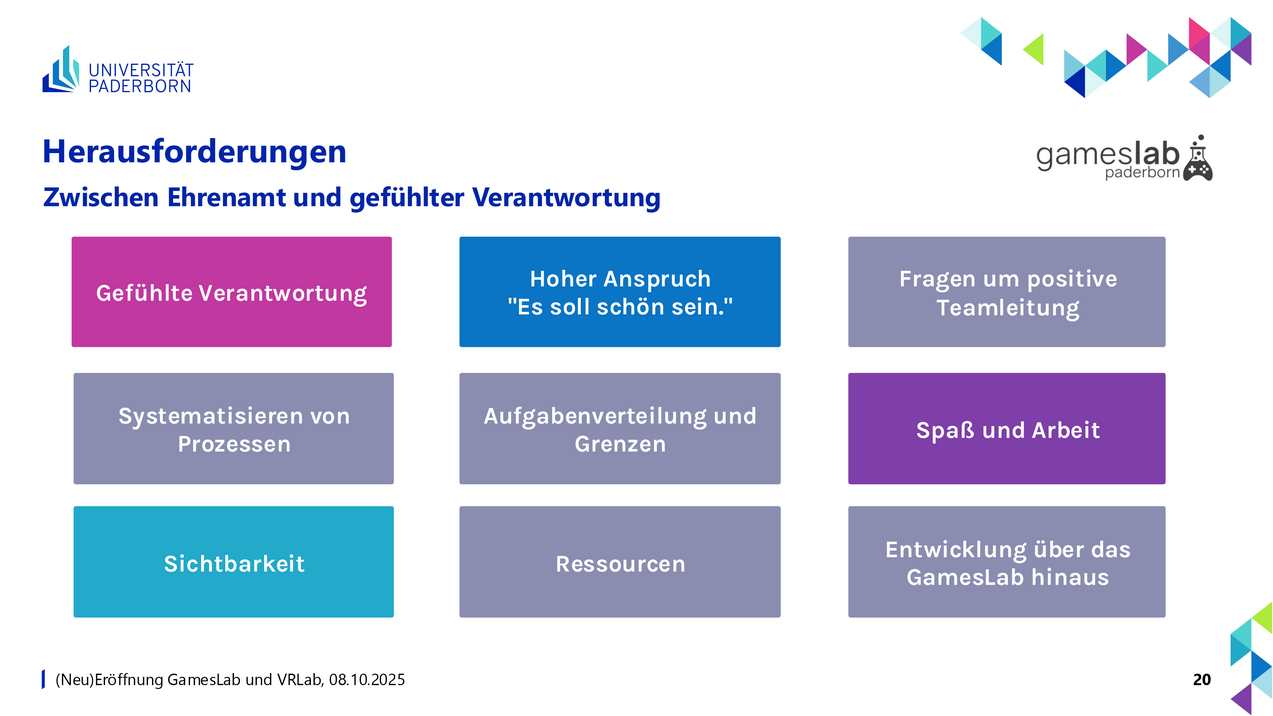
A special feature of the organisation's work is that it is mainly done on a voluntary basis. The GamesLab was created "bottom up" from the intrinsic motivation to give video games and the conceptual and technical effort behind them more relevance and attention. Very few people realise that most of the organisation work is based on voluntary commitment and actually requires a lot of resources.

One hurdle that organisers have to face time and again is the question of how the perceived responsibility is negotiated. How the division of labour is sensibly organised so that individual members of the organisation do not have to carry too much of the load compared to others are also leadership and management issues that the organisation has to deal with. Few people know how much work is involved. How much effort lies behind the conception and management of such a large course, or how much energy goes into making it as exciting, fun and educational as possible for our participants.

Maintaining the GamesLab and ensuring that it remains relevant and important are things that the organisation is committed to. Even the organising generations before us have had to manage technical, content-related, organisational, bureaucratic or resource-based hurdles behind the scenes - and this is still a large part of the invisible organising work for which we are actively trying to develop solutions.

Why we like be­ing "the or­gan­isa­tion"

The work in the organisation is very extensive and at the same time very enriching. Many of us learn more about ourselves as part of our involvement. Above all, however, we learn important practical and organisational skills in project management, team leadership, solution-oriented and positive communication, process organisation, independent work, time management and many other soft skills that are important in everyday working life.

We are lucky to be able to work and cooperate closely with Professor Christian Fuchs, Sebastian Krois, Volker Spaarmann and other important people from ZIM. The GamesLab is a student initiative that is allowed to design and further develop ideas and concepts in the context of teaching by and for students.

Fur­ther in­sights be­hind the scenes

Wall of Fame - The faces behind the organisation

In the Wall of Fame you will find current faces of the organisers and past generations of organisers. GamesLab thrives on the commitment and creativity of our organisers, which is why we want to honour them here for their efforts.

Learn more

GamesLab history

The beginnings of the GamesLab date back to 2008, when professor Dr Jörg Müller-Lietzkow started seminars on the development of game projects - at that time without a dedicated room or hardware. On 10 July 2010, the GamesLab at Paderborn University was officially opened.

Learn more

Premises

The GamesLab is a space provided by the ZIM of Paderborn University for collaborative learning and teaching in the field of video game development. Together with the VRLab branch, the GamesLab offers almost 35 workstations equipped with the necessary software and hardware. Come and visit us!

Learn more