
Game analysis and game studies
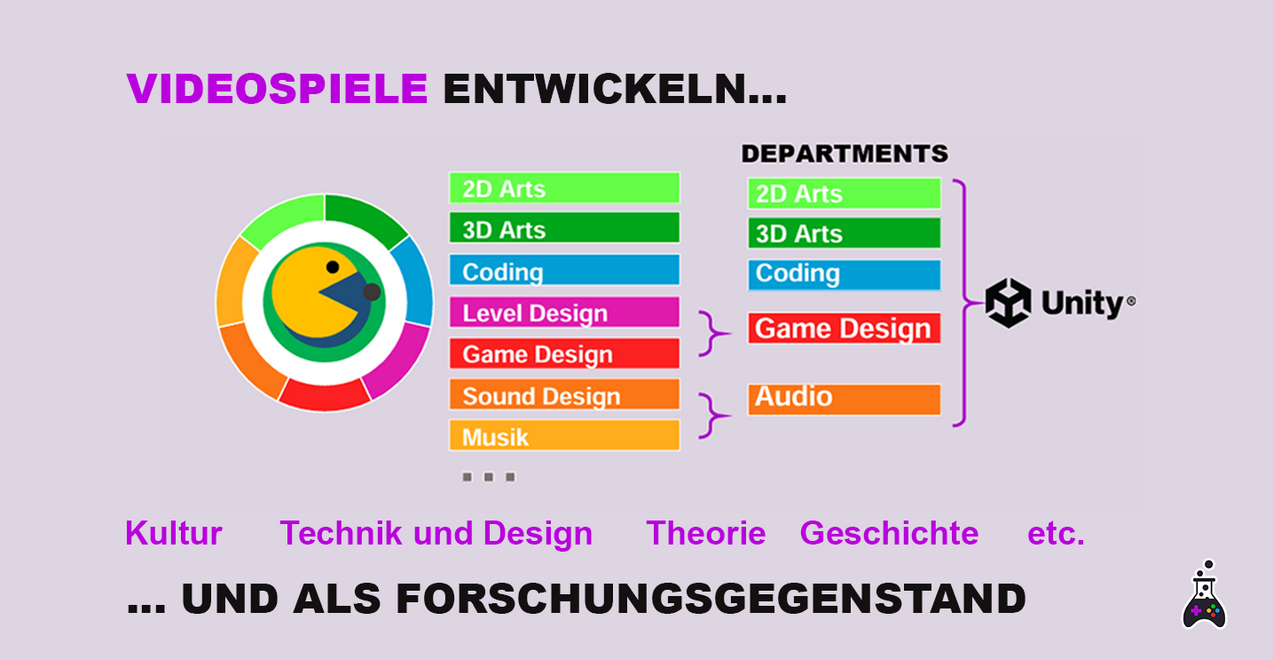
What are game studies?
Game studies analyses, among other things, the influence games have on society and culture (cf. Thon 2015: 105). The central question is: How exactly, i.e. through which processes, systems, practices and structures, does their influence manifest itself? In addition, Katie Salen and Eric Zimmerman, for example, assume with their approach "Games as Cultural Rhetoric" that games and their structures are a mirror of the prevailing culture and its inherent values (cf. Salen & Zimmerman 2004: 514-535).
Accordingly, the social or cultural processes, systems, practices and structures from which games emerge are also scrutinised - which social values, norms or even habitus they reflect, without these having been explicitly "programmed into" the medium (Bogost 2008: 128f, 136). Games or partial aspects of them can therefore also be critically scrutinised and examined as an object of research with regard to economic, political, ethical and other perspectives.
Why game studies and games research are important
Social potential of video games
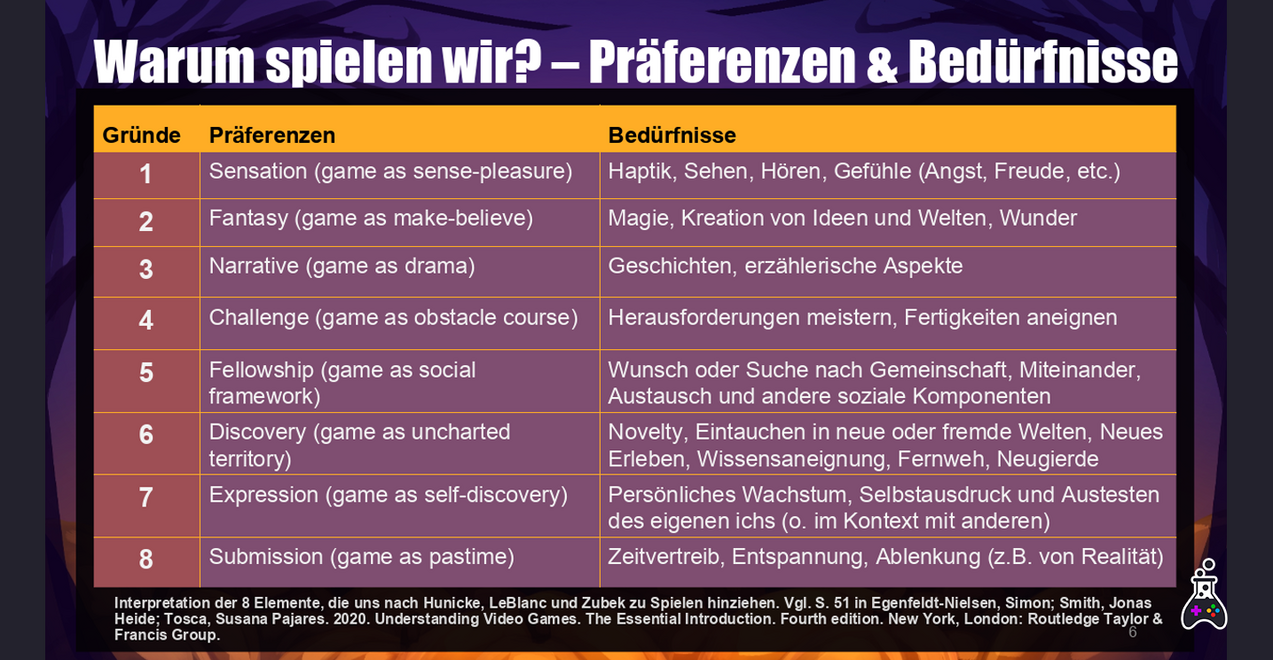
According to the canon of game studies, "playing" is an inherent human need and games are accordingly about serving a wide variety of emotional or social needs. Games are often reduced to being played for fun, a trivial pastime or for distraction (cf. Bogost 2008: 137). Although games are entertaining in nature, the reasons why we play and what kind of entertainment someone is looking for are not just aimed at the same version of "play" or entertainment.
Instead, the rhetoric of games and "play" is categorised differently historically and also in its aims and connotations, as for example in Brian-Sutton Smith's Seven Rhetorics of Play (cf. Salen & Zimmerman 2003: 518f.). These include "play as progress", which aims at the cognitive development of the mind; "play as power", which we find in sports or competitions and refers to social status; or "play as identity", which reflects the creation and communication of identity in a society. A categorisation for the serving of emotions and intrinsic motivation of "play" can be seen above according to Hunicke, LeBlanc and Zubek (see figure above).
Relevance of the integration of game studies content in the course
As Bogost states: ""Video games make arguments about how social or cultural systems work in the world - or how they could work, or don't work. [...] In this way, playing video games is a kind of literacy. Not the literacy that helps us read books or write term papers, but the kind of literacy that helps us make or critique the systems we live in. By 'systems,' I don't mean large-scale, impersonal things like political systems. Any social or cultural practice can be understood as a set of processes, and our understanding of each of them can be taught, supported, or challenged through video games" - Bogost 2008, p.136.
Game studies help to unleash a potential in the development of games that is only niche-anchored in the consciousness of society outside the university framework. If students try to incorporate parts of this thinking into their designs, then we are laying the foundations for a generation of media producers who could change society in the long term.
Vocabulary list for game analysis
At GamesLab, we differentiate between two different aspects of "genre" due to the specific mediality of video games:
Thematic genre
The thematic genre refers more to the context in which the game's setting and story are set. The thematic genre overlaps with the usual understanding of genre, such as in books or films, for example: Fantasy, Science Fiction or Medieval and many more.
Mechanical genre
The mechanical genre refers to game principles and conventions, i.e. what type of gameplay is presented. There are, for example, puzzle, roguelite/ -like, metroidvania, platformer, serious game and many more.
"Point of View" (PoV) comes from English, but is also known in German as a narrative perspective. Unlike in literary works, however, PoV in games refers to the technical point of view of the gameplay. From which perspective can players view and perceive the audiovisual actions? However, PoV in games also overlaps with the meaning of the narrative perspective, which is important in the design of the narrative, i.e. the game narrative.
In a game, the narrative is the story that is being told. Similar to books or films, it is the story that is depicted. However, a game narrative differs from the mode of "narration" in the literary sense due to its mode of "simulation" (cf. Gonzalo Frasca, "Simulation Rules"). A game narrative is made up of other aspects, such as interactive elements, procedurality, room for manoeuvre (cf. Ian Bogost) and also the internal rules of the game.
Vocabulary list for Game Studies
Brian-Sutton Smith is generally concerned with ludology and has developed the concept of the "Seven Rhetorics of Play".
Espen Aarseth is one of the pioneering authors of game studies. At the turn of the millennium, he called for the development of a new and independent academic discipline for video games (cf. Thon 2015:107).
Ian Bogost is a game designer and lecturer who focuses in particular on critical readings of video games. The concepts of "persuasive games", "procedural rhetoric" and "procedural literacy" are at the core of his work.
Janet H. Murray is a pioneer in the field of narration in video games and is jointly responsible for the development of a new mediality for digital media. In her book "Hamlet on the Holodeck", she set out four fundamental characteristics of digital artefacts: "prodedurality, participation, spaciality and encyclopedic scope" (cf. Bogost 2008: 121).
Gonzalo Frasca is one of the pioneering authors of game studies. His work on "Simulation Rules" is decisive in detaching games from literary studies and the linear mode of narration.
Katie Salen and Eric Zimmerman examine games from many perspectives and provide a comprehensive introduction to practical and theoretical aspects of game development and its social potential with "Rules of Play: Game Design Fundamentals" and "The Game Design Reader: A Rules of Play Anthology".
Video games are computer-based media. This means that they are inherently process-based. The special mediality of video games includes the following aspects:
- Procedurality, conditions and (game) rules
- Approaches and calculations
- Digital and analogue aspects, physical components (medium and human)
- mode of simulation, referencing and constructing reality
Some authors have differing opinions as to the extent to which programme code is taken into account concretely or indirectly.
Narration
The term narration is commonly used in literary studies to refer to a narrative in the literary sense. There is a narrative perspective and a setting in which successive events form a story (cf. Thon 2015: 57). The mode of narration is therefore linear.
Simulation
In the simulation mode, the focus is on behaviour, action spaces and possibilities (cf. Bogost 2008, 120f). This means that games do not depict reality like photos, for example, but rather construct reality. A photo can capture a concrete moment and show the representation of a reality. However, a game only references assumptions that have been defined for the calculations in the background and only shows approximations and interpretations of that referenced, assumed reality.
Procedurality describes how everything that becomes visible and tangible in video games is based on a series of assumptions, calculations and referenced rules as well as the interpretation of these rules (cf. Bogost 2007, 2008; Juul 2010; Salen & Zimmerman 2004). A range of information must first be processed in order to generate content that can be passed on to the players.
Agency describes the levels of action and agency of players. Because they are simultaneously subjects outside the medium and are not just cognitively drawn into a narrative (cf. Bogost 2006, 67), games offer immersive interaction possibilities. Actively playing and exploring the possibilities between possibly fixed narrative stations and free movement in the game is a free space that is particular to the game medium.
Bibliography
Bogost, Ian (2007): Persuasive games: the expressive power of videogames. Cambridge, Mass. [et al:] MIT Press.
Bogost, Ian (2008): The Rhetoric of Video Games. In: Katie Salen Tekinbaş (ed.): The Ecology of Games. Connecting Youth, Games, and Learning. Cambridge, Massachusetts: MIT Press (The John D. and Catherine T. Macarthur Foundation Series on Digital Media and Learning), 10.1162/dmal.9780262693646.117, pp.117-140.
Frasca, Gonzalo (2003): Simulation versus Narrative. Introduction to Ludology. In: Mark J.P. Wolf, Bernard Perron (eds.): The Video Game Theory Reader. New York. S.221-235.
Hunicke, LeBlanc and Zubek In Egenfeldt-Nielsen, Simon; Smith, Jonas Heide; Tosca, Susana Pajares. (2020): Understanding Video Games. The Essential Introduction. Fourth edition. New York, London: Routledge Taylor & Francis Group.
Juul, Jesper (2010): The Game, the Player, the World: Looking for a Heart of Gameness. Plurais Revista Multidisciplinar 2010: 248-270. https://doi.org/10.29378/plurais.2447-937.
Salen, Katie & Zimmerman, Eric (2003): Rules of Play. Game Design Fundamentals. Cambridge, Massachusetts, London: The MIT Press.
Salen, Katie & Zimmerman, Eric (2004): Games as Cultural Rhetoric. In: Rules of Play. Game Design Fundamentals, pp.514-535. Cambridge, Massachusetts, London: The MIT Press.
Thon, Jan-Noel (2015): Games Studies and Narratology. In: Klaus Sachs-Hombach, Jan-Noël Thon (eds.): Game Studies. Current approaches in computer game research. Cologne, pp.104-164.
Research and text: Gina Meusel - Media Studies B.A.